Labouring Beside Lough Erne
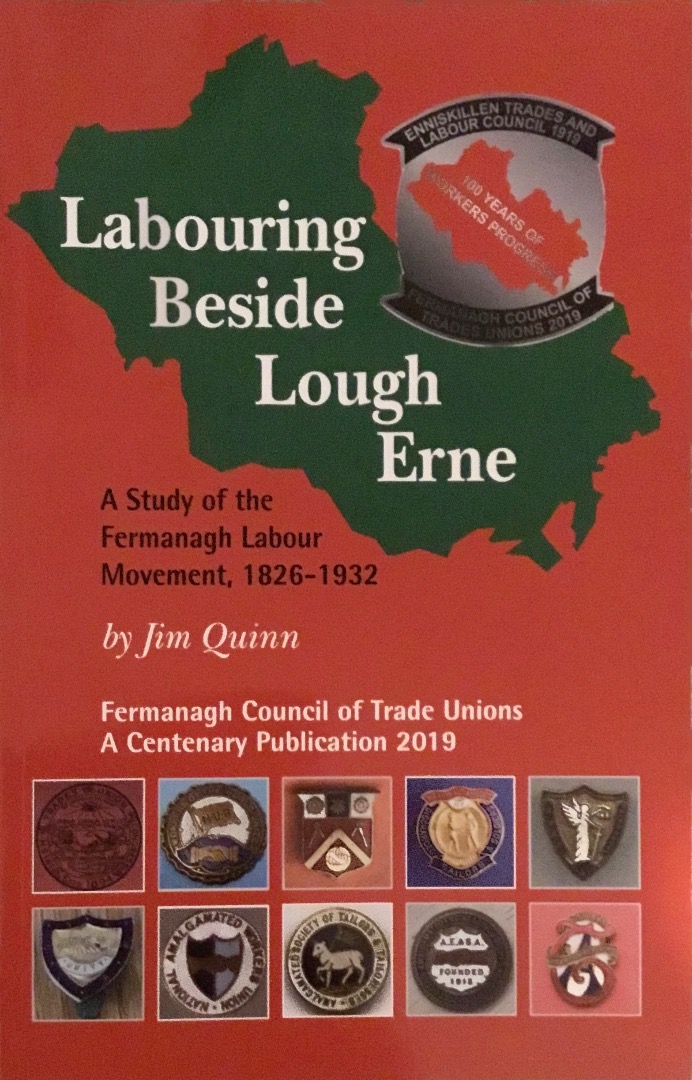
Labouring Beside Lough Erne
“Jim Quinn: Labouring Beside Lough Erne, a Study of the Fermanagh Labour Movement 1826-1932. DUBLIN: Umiskin Press 76 pages ISBN 978 1 9164489 2 6.
This is the first part of a projected three-part history of the labour movement in County Fermanagh from the early nineteenth century to the present day. Jim Quinn, a former secretary of the Fermanagh Council of Trade Unions, and a holder of a diploma in Labour Studies from Ruskin College, Oxford, is well qualified to undertake this study, and does not disappoint.
References to trade union activity in early nineteenth century Fermanagh are few and far between but Quinn has unearthed several valuable references in the local press. In 1826 for instance he has found an advertisement giving notice that local masons and bricklayers were working fixed hours with specified breaks. ‘The notice suggests that skilled artisans were organised in craft societies before this period in Fermanagh as it refers to applying previous customs,’ suggests Quinn.
In 1834 Enniskillen bakers and tailors were organising themselves in trade unions, to the dismay of the local ascendancy who threatened ‘to give their names to the judiciary and have them deported to Australia for allegedly being involved in an illegal combination.’ This was the era of the Todpuddle Martyrs, and also one of considerable sectarian tension in Ireland; the authorities had the powers to suppress the workers so this was no idle threat.
The tailors are mentioned again in 1854 when the Amalgamated Society of Tailors set up a branch in Fermanagh and in 1865 they became involved in a dispute with a prominent local draper William Carson who refused to recognise the union or pay the nationally agreed rates of pay. In 1890 they were in dispute with another master tailor. The author has also found reports of a strike at the Belleek pottery in 1888 but admits that references to trade union activity are pretty sparse in this period.
Where this book is particularly interesting and revealing is when it moves into the early twentieth century. By 1904 the Irish National Teachers Organisation had been organised in the county and in 1908 shop assistants agitated for a weekly half-holiday. However national and international affairs were to dominate the coverage in the local newspapers. Quinn notes that there was a great upsurge in union membership during WW1 and especially after the Easter Rising. However he qualifies this by saying that ‘While the ITGWU were successful in a line south of Dundalk to Sligo, in Ulster they did not penetrate very deeply, mainly because their known Nationalist sympathies alienated Protestant workers. In the North therefore, British-based unions held sway.’ According to Quinn in 1917 eight out of the ten unions active in Fermanagh were British based. He notes an absence of unions for the unskilled or for agricultural workers. ‘Trade unions were either of the craft or industrial variety.’ There were no recorded strikes in Fermanagh during the first world war, ‘due to the predominance of British-based unions’ and also due to the stringent wartime regulations such as the Defence of the Realm Act.
However before the war had ended a branch of the National Amalgamated Union of Labour (NAUL), a union for unskilled and semi-skilled labourers was established in Enniskillen and the threat of conscription which loomed in the spring of 1918 gave impetus to the union though in Fermanagh it stopped short of joining the one day national strike on 23 April for fear of alienating Protestant workers. When the risk of conscription subsided the union began agitating for better pay and with the end of the war it became very active both in Enniskillen and in rural areas.
The Enniskillen Trades and Labour Council was formed in 1919 and this book has been published as part of its centenary commemorations. The ET&LC was soon involved in a dispute, supporting local building workers who striking for better hours and pay. The success of this campaign was a great boost for the ET&LC.
However national politics would soon muddy the waters and the Ulster Workers’ Trade Union which was set up in December 1918 to oppose what was seen as an alliance between labour and nationalism formed a branch in Enniskillen Orange Hall in May 1919. Nevertheless the mainstream labour movement in Fermanagh retained cross-community support among workers and as Quinn notes the three Labour councillors elected in 1920 were all ex-servicemen. However all three were Catholics and one of them Frank Carney would soon become a leading IRA figure in Fermanagh and later a Fianna Fáil TD in Donegal. Labour candidates got close to 20% of the vote.
Labour had three councillors out of 21 and they generally aligned themselves with the Nationalists. In the years that followed as local government in the county became dominated by Unionists their role in local government was not very significant. Only in the field of housing did they have some success. For years the council had refused to build houses but long agitation by councillors Jones and Kelly eventually produced results and two rows of houses which bore their names were built – Jones’s Cottages and Kelly’s Cottages. Labour in Fermanagh was not defeated by sectarian division. It continued to represent the workers and to have success in its campaigns for better wages and conditions. However its efforts in the local councils were largely stymied by a unionist dominated regime.
This is a useful and interesting book. Quinn has made good use of local sources, especially the local press and he has shown that the labour movement has played an important role in Fermanagh over the last 150 years. The book is well produced with a number of full-colour illustrations. Hopefully it will remind readers, both locally and further afield, that Irish history isn’t simply orange and green.
Séamas Mac Annaidh
Labouring Beside Lough Erne is available for £10 plus post &packaging from the author at jim.quinn@btinternet.com or by contacting Enniskillen Castle Museum Shop at https://fermanaghandomagh.digitickets.co.uk/products/282979?navItem=659231